Preparation · 28 July 2026 · 9 min read
Wedding venue in Amsterdam on the water: the complete guide to quay, route and ceremony
A wedding venue in Amsterdam needn't be a hall. The quay where your guests board is the first image of the day, and so a choice that deserves just as much attention as the vessel itself. Those who marry on the water aren't choosing one location but a route through the city, with a beginning, a highlight and a homecoming.
by Elise Rijkes
Why Amsterdam is the ideal city for a floating wedding venue
Few cities combine a historic centre, open water and a lively harbour as closely together as Amsterdam. Within an hour's sailing, the intimacy of the canals lies beside the space of the IJ and the vastness of the Markermeer. That variety makes Amsterdam supremely suited to a wedding on the water, whether you choose a saloon boat, a historic classic tall ship or a classic steamship.
A floating wedding venue in Amsterdam also means the city itself becomes part of your wedding photographs. Façades, bridges and the skyline glide past while you're aboard, with no permit required for a separate photo location. The backdrop changes of its own accord, every quarter of an hour.
The city as a starting point
Boarding in the centre gives an immediate feel of Amsterdam: narrow quays, façades, bridges that open just in time. It's intimate and photogenic, but calls for clear directions for guests and vessels that fit beneath the bridges. Think of a saloon boat with a retractable superstructure or a compact sloop.
On the IJ, there is more space, logistics are simpler and the skyline is close by. For parties above 60 guests, this is almost always the more comfortable choice, since there are more jetties with good accessibility for cars and taxis.
Prefer to depart entirely outside the city? Quiet boarding points also lie on the Markermeer and IJmeer, ideal for couples who want to feel space and calm from the very first moment, rather than bustle.
Guest arrival: first impressions count
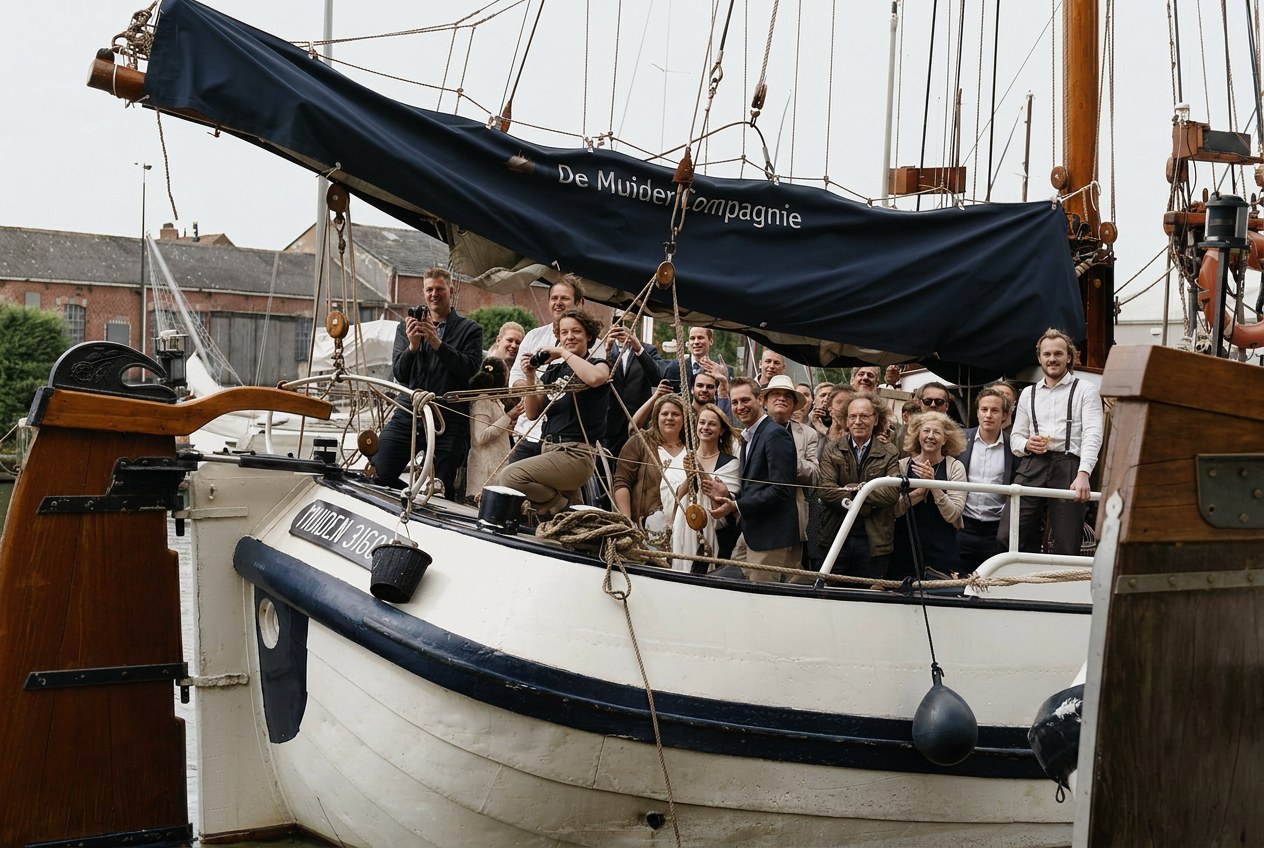
Allow a thirty-minute boarding window, with a glass in hand on the quay while the vessel is made ready. Ensure accessibility by taxi and public transport, and communicate the exact jetty rather than just a street name. A map link in the invitation prevents lost guests and stressed phone calls just before departure.
Those wishing to bring guests from hotel to vessel can do so over water with a sloop transfer. That turns the journey into part of the day rather than an obligatory stop, and gives guests a taste of the wedding's atmosphere before the ceremony has even begun.
For larger parties, allow for two boarding moments, so no one has to wait in the cold or rain. We always plan this with a margin, so a small delay never throws the rest of the schedule off balance.
The official ceremony on board
A legally binding ceremony requires a designated wedding venue and a municipal registrar. Not every vessel is registered as such, and not every municipality works with floating venues in the same way. Many couples therefore choose a brief official ceremony on land, followed by a full, personal ceremony on board where the emotion and the story are given proper room.
We coordinate this with the municipality and plan it so there's no rush between the two moments. In practice, that means a compact official act early in the day and the real vows later, on the most beautiful stretch of water on the route.
Comparing cruising areas: canal, IJ or Markermeer
The canals offer intimacy and backdrop, with limited clearance and therefore smaller vessels. The IJ is more spacious and logistically simpler, with the skyline as a permanent backdrop. The Markermeer and IJmeer offer wide skies, more room to move and the chance to actually sail a historic classic tall ship.
The choice depends greatly on the feeling you're after. If you want guests waving and applauding from bridges, choose the canals. If you want the city to disappear beyond the horizon and the party to feel entirely its own, choose the Markermeer.
Practical logistics: bridges, locks and time windows
Amsterdam has many bridges with fixed or moveable clearances, and some routes require a bridge to be opened by appointment. Larger vessels therefore have fixed sailing windows, especially when passing through locks between the IJ and the Markermeer.
We always factor in waiting times and peak moments on the water when planning, so the vows never accidentally coincide with a queue of sightseeing boats. A well-plotted route is at least as important as the choice of vessel.
Choosing the season and time for the best venue experience
In summer, the water is busiest between four and seven in the afternoon, which slows sailing but livens the atmosphere. A ceremony early in the afternoon or late in the evening gives more calm and better light. Outside the high season, between October and April, the city is quieter, and a heated saloon boat has a unique, intimate charm precisely then.
For photographs with the setting sun over the water, plan the ceremony or the first glass within the last hour before sunset. That moment differs by location across Amsterdam, and we tailor the schedule to it, season by season.
Why a dedicated wedding planner makes the difference
A wedding venue on the water has more variables than a hall on land: tide, bridges, weather and municipal rules all play a part. Elise Rijkes guides couples from the first choice of location to the last mooring line, ensuring quay, route and ceremony align without you having to work out the logistics yourselves.
In practice, that means you have just a single point of contact on the wedding day itself, one who already knows the skipper, the municipality and the suppliers before you even step aboard.
"The quay where your guests board is the first image of the day. Choose it with just as much care as the vessel."
Frequently asked questions
- Can any vessel in Amsterdam be used for an official wedding ceremony?
- No, only vessels designated by the municipality as a wedding venue may host a legally binding ceremony. That's why many couples choose a brief official ceremony on land and an extended, personal ceremony on board.
- Where's the best place for guests to board for a wedding on the water in Amsterdam?
- That depends on the group size and the cruising area. For smaller parties, a quay in the centre works well for atmosphere; for larger groups, a jetty on the IJ is often more practical thanks to better accessibility.
- How much time should I allow for boarding guests?
- Allow around thirty minutes for smooth boarding with a welcome drink on the quay. For larger parties, it's wise to plan two boarding moments.
- Is marrying on the canals possible with a larger party?
- Only to a limited extent. Clearance within the canal ring limits vessel size, so larger vessels don't fit. From around 60 guests, sailing on the IJ or Markermeer is often more practical.
- What happens in bad weather on the wedding day?
- All vessels have a covered or heated alternative on board, and the route can be flexibly adjusted. Good planning always accounts for a weather alternative without changing the atmosphere of the day.
- Can a sloop transfer be combined with a larger vessel?
- Yes, many couples first have guests sailed from the hotel to the main vessel by sloop. That makes the arrival part of the experience and prevents waiting on the quay.
In the mood to talk it through?
One dedicated point of contact, from first idea to the final mooring line.
Plan a conversation