Mood & styling · 14 April 2026 · 8 min read
Flowers and styling for a wedding reception on the water: what works and what doesn't
Styling on the water has one extra design rule that doesn't exist on land: everything must still look beautiful when the wind picks up. This isn't a limitation but a direction our florist translates into sturdy, weather-resistant beauty for every wedding.
by Atelier Waterbruiloft
Why styling on the water differs from styling on land
On land, you can set flowers and decor down and everything stays exactly as intended. On a vessel, wind, engine vibration and sometimes a gentle swell come into play, especially on open water such as the IJmeer or Markermeer. A composition that looks static and stable on land can lose its shape within ten minutes on the water.
Our florist therefore never designs independently of the vessel, but with the vessel as the starting point. Every choice of material, height and fixing is tested against one question: will this hold at twenty kilometres an hour of wind over open water?
Low, dense and structured
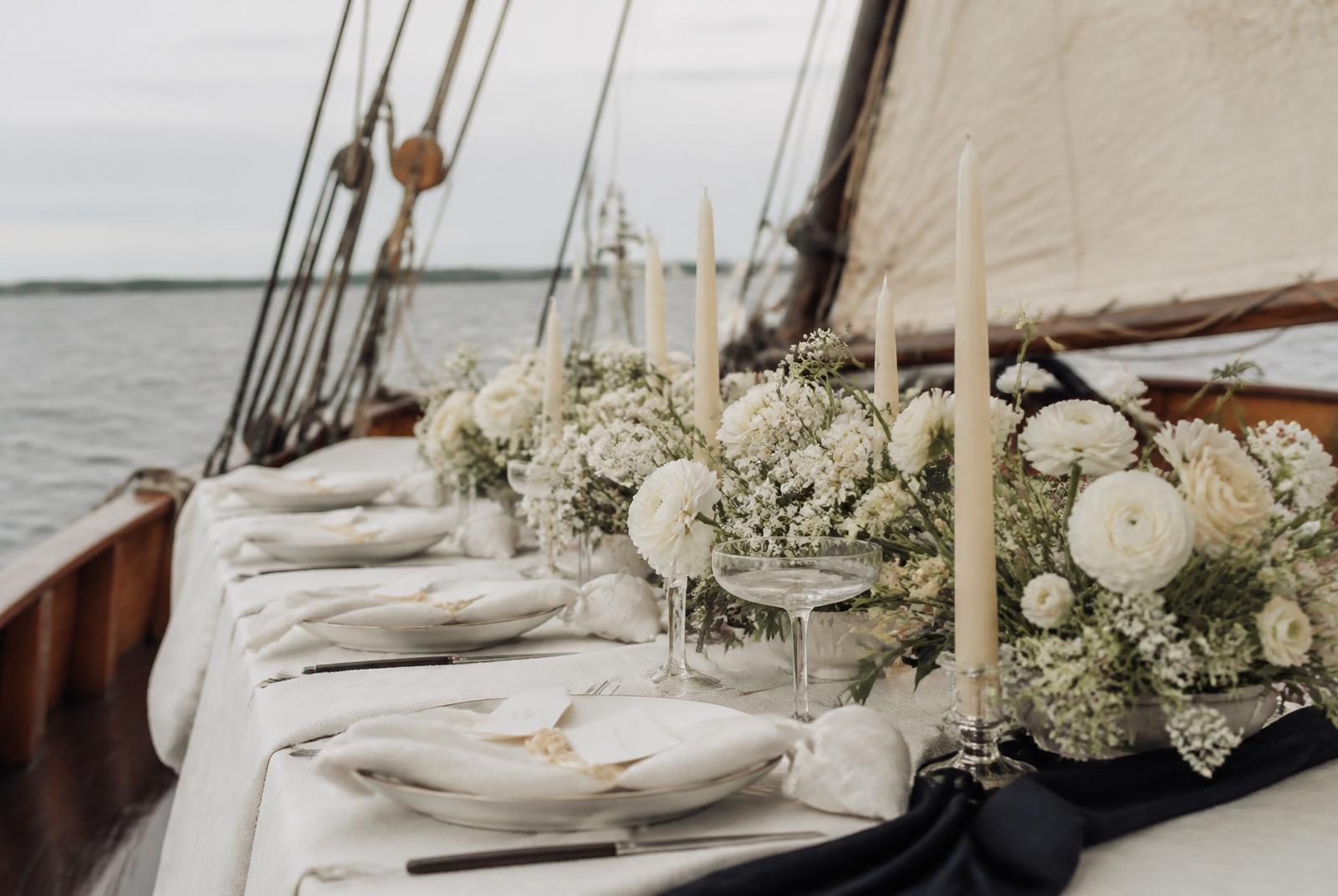
We work with compact arrangements, sturdy stems and materials that withstand movement: olive, eucalyptus, ornamental grasses and roses with closed hearts rather than fully opened blooms. These flowers look romantic yet are sturdy enough to weather the wind without fraying.
Tall vases and loose, swaying branches deliberately stay on land. Instead, we choose low, wide bowls that sit stably on the table and won't tip with a slight tilt of the vessel.
The same principle applies to bridal bouquets: a more densely bound bouquet with sturdy stems looks just as refined in deck photographs as a looser bouquet, but survives the wind without losing petals during the ceremony.
Candlelight that stays lit
Open flames and wind rarely mix well, so we choose deliberately by location on board. On deck, we work with lanterns and glass storm shades with a high rim, which protect the flame without weighing the decor down. Weighted-base wind lights also prevent decor from toppling in an unexpected gust.
Indoors, in the saloon or under the awning of a classic tall ship, the flame may stand more freely, since shelter there is greater. This contrast between protected light on deck and open flames indoors creates a natural shift in atmosphere between outside and in.
The evening thus stays warmly lit, even when a stiff breeze blows across the IJ or the Markermeer.
Table styling that follows the vessel's movement
Tableware, glassware and decorative elements are deliberately kept low and stable at a wedding on the water. We avoid tall candlesticks and unstable arrangements, choosing instead a layered table styling with varying heights that never rise above the knee height of a seated guest.
Linens and table runners are lightly weighted at the edges, so a gust of wind on deck doesn't immediately disturb the whole table setting. These details are invisible to guests, but ensure the styling stays intact all day.
Colour choices and the light on the water
Light on the water differs from light on land, reflecting off the water's surface and changing with the season and time of day. Soft, warm tones such as ivory, salmon and terracotta work particularly well during golden hour, while fresher tones such as eucalyptus green and white come into their own on a bright afternoon with plenty of sunshine.
Our florist therefore always matches colour choices to both the season and the planned time of the ceremony, so the flowers don't compete with the light but instead enhance it.
Fixing and material choices on board
All decor on board is fixed with the vessel's regulations in mind: no open flame without protection, no unstable objects that might topple, and materials that can be removed quickly and easily on arrival in port. Floral installations along the railing are secured with sturdy, invisible binding material resistant to wind and light rain.
For a classic tall ship, we also take the sails and rigging into account, so decor never gets in the way when the sails are hoisted or lowered.
Seasonal flower choices
In spring, we choose ranunculus, anemone and grape hyacinth, combined with sturdy foliage that withstands the wind well. In summer, sunflowers, dahlias and dense roses work particularly well on open water, where strong sun and wind call for more robust blooms.
In autumn, we choose amaranth, chrysanthemum and autumn leaves in warm tones that suit the early golden hour perfectly, and in winter we work with winter greenery, amaryllis and berried branches that keep their colour and firmness even at low temperatures.
"A bouquet that survives on open water is never less beautiful than one that can only exist on land. It is simply built more cleverly."
Frequently asked questions
- Can flowers on open water be just as beautiful as on land?
- Yes, with the right choice of materials, bouquets and table styling on open water remain at least as beautiful as on land. It simply calls for more compact arrangements and sturdier stems.
- Can candles be placed on deck during the wedding?
- On deck we work with lanterns and glass storm shades with a high rim that protect the flame from the wind. Fully open flames are reserved for sheltered spots indoors.
- Is the styling matched to the season?
- Yes, our florist chooses flower varieties and colours by season, from ranunculus in spring to winter greenery and amaryllis in winter, always matched to the light of the planned ceremony.
- Does your styling also work on a classic tall ship?
- Certainly — in that case, we also take the rigging and sails into account, so decor never gets in the way when they are hoisted or lowered.
In the mood to talk it through?
One dedicated point of contact, from first idea to the final mooring line.
Plan a conversation